
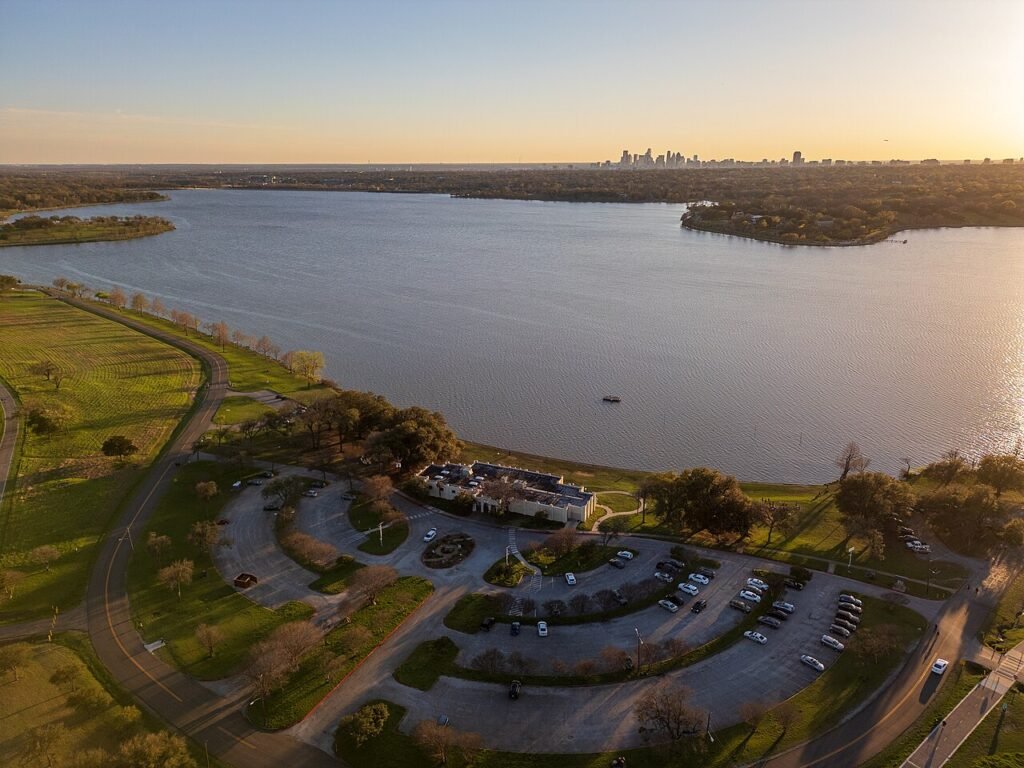
Every city has a ghost story it tells on dark roads. Dallas has a girl in a wet white dress at White Rock Lake.
You probably know how it goes. A young woman, soaked to the skin, waves down a car near the lake at night. She says she needs to get home and gives an address. Somewhere along the way the back seat goes quiet. When the driver turns around, she’s gone, and the seat is still wet. At the house, someone answers the door and tells them the girl they’re describing drowned in White Rock Lake.
That’s the legend. I wanted to know who she was. So I went through old newspapers, genealogy records, death certificates and documented deaths at the lake, looking for the real woman behind the story.
Instead of one woman, I found three.
The Earliest Version We Can Trace
In 1943, Anne Clark published “The Ghost of White Rock” in Backwoods to Border, a collection from the Texas Folklore Society. In her telling, a young couple is parked by the lake on a hot July night when a girl in a soaking-wet white dress walks up to the car. Her boat overturned, she says. Everyone else is safe. She just needs to get home.
She gives them an address in Oak Cliff and climbs into the rumble seat so she won’t get the other girl wet. On the drive, they turn around to say something to her. She’s gone. The rumble seat is still wet. At the Oak Cliff address, a man tells them they aren’t the first to come to his door with that story. His daughter drowned in the lake a few weeks earlier.
That’s folklore. No death certificate names a passenger who vanished from a car. But it tells us something useful: by 1943, the Lady was in print. That gave me a place to start looking backward.
Hallie Gaston, 1927
Hallie Enid Gaston died at White Rock Lake in May 1927, more than fifteen years before Clark’s story was published. She was about twenty years old, and her death involved a boating accident.
Remember what the girl in the earliest version says. Her boat overturned.
That doesn’t make Hallie the Lady of White Rock Lake. I haven’t found anything showing Clark based her story on Hallie, and some details of Hallie’s real death don’t line up with the legend. But she is the name that comes up most often as a possible inspiration, and once you have a name on a death certificate, you’re not dealing with a ghost anymore. You’re dealing with a young woman who had parents and a life before the lake became the last line of her story.
Louise Ford Davis, 1935
Louise Ford Davis died at White Rock Lake on July 5, 1935. She had been staying at the Melrose Court Hotel in Dallas. Her sister found a note, and officers went toward the lake looking for her. A detective spotted her in the water. She was pulled out, but they couldn’t save her.
Louise was a grown woman, a good deal older than the girl in the legend. Her story doesn’t fit neatly, and I’m not going to make it fit. But she was a real woman whose life ended in that water before the legend was published, and her name belongs in this conversation.
Rose Stone, 1942
Rose Stone was from Mansfield, Texas. She died in White Rock Lake in November 1942, only months before Clark’s version appeared in print. She was thirty-five, and accounts describe her wearing a sweater and skirt.
That doesn’t sound much like a girl in a wet white dress. And the legend seems to have been going around before Clark wrote it down, so Rose didn’t start it. What her story shows is how folklore grows around a real place. Every new tragedy at the lake gave people another real story to attach to one they were already telling.
The Story Keeps Moving
Ten years after Clark, Frank X. Tolbert told it again in his 1953 book Neiman-Marcus, Texas. This time the couple is Guy Malloy and his wife, and the passenger is a beautiful blonde in a fine dress. She doesn’t want to go to Oak Cliff. She wants to go to Gaston Avenue.
Gaston Avenue. Hallie Gaston. When I read that, I stopped. But a coincidence isn’t evidence, and I haven’t found anything connecting that street in the later story to Hallie. That’s exactly where folklore can get away from us if we aren’t careful.
What we can document is more interesting anyway. The story keeps changing. She needs Oak Cliff, then Gaston Avenue. A boat overturns, or she falls from a pier. Her dress changes. The people who stop for her change. Only the bones stay put: a wet young woman by the lake, a ride home, an empty seat.
Folklorists call that the vanishing hitchhiker, and versions of it turn up all over the country. Dallas just gave it its own lake, its own streets and its own Lady.
So, Who Was She?
I can’t tell you which of these women, if any, became the Lady of White Rock Lake. After nearly a century of retelling, nobody can.
What I found is something I like better. Hallie Gaston. Louise Ford Davis. Rose Stone. Three real women whose names deserve to be remembered on their own, apart from the ghost.
Sometimes folklore doesn’t give you an answer. It gives you a trail. Follow it far enough and you find the real people who were there before the legend took over.
We filmed this story for Tesla Time Travels. Watch it on YouTube, and find our Ranch Lifestyle™ jewelry at teslatimetravels.com.
Sources: Anne Clark, “The Ghost of White Rock,” in Backwoods to Border, Texas Folklore Society, 1943; Frank X. Tolbert, Neiman-Marcus, Texas, 1953; White Rock Lake Conservancy: The Lady of the Lake; Advocate: Another possible White Rock Lake drowning; Dallas County death records and newspaper accounts, 1927, 1935 and 1942.